After a year of building the right data foundation, we're launching the Kinn Agent. An AI layer that lets you query your entire player community the way you'd talk to a teammate.

We're officially one year in since we pushed the first version of Kinn to life. What started as a simple Figma file demo, to a single connection topic generator prototype has evolved in to something we are so proud of. In that year, we've learned a lot. Our dearest thanks go out to our earliest supporters and beta users. All of your feedback and criticism has been more helpful than we could have ever imagined.
From the get-go, Kinn was designed and oriented around topic generation. The idea was that we could connect and aggregate commentary from Discord and Steam, and help teams understand sentiment on a topical level. And while, it was an interesting idea to start, there were a few critical findings that came out of that.
First, topics were really cool, but they were way to hard to parse, and felt like it was just validating things teams already knew. And once they were generated, it felt like topics just existed on a dashboard, and there wasn't any real outcome because of it. It helped us understand the core of the product was still solid, but it was the wrong experience and there needed to be a faster way to get to the heart of issues.
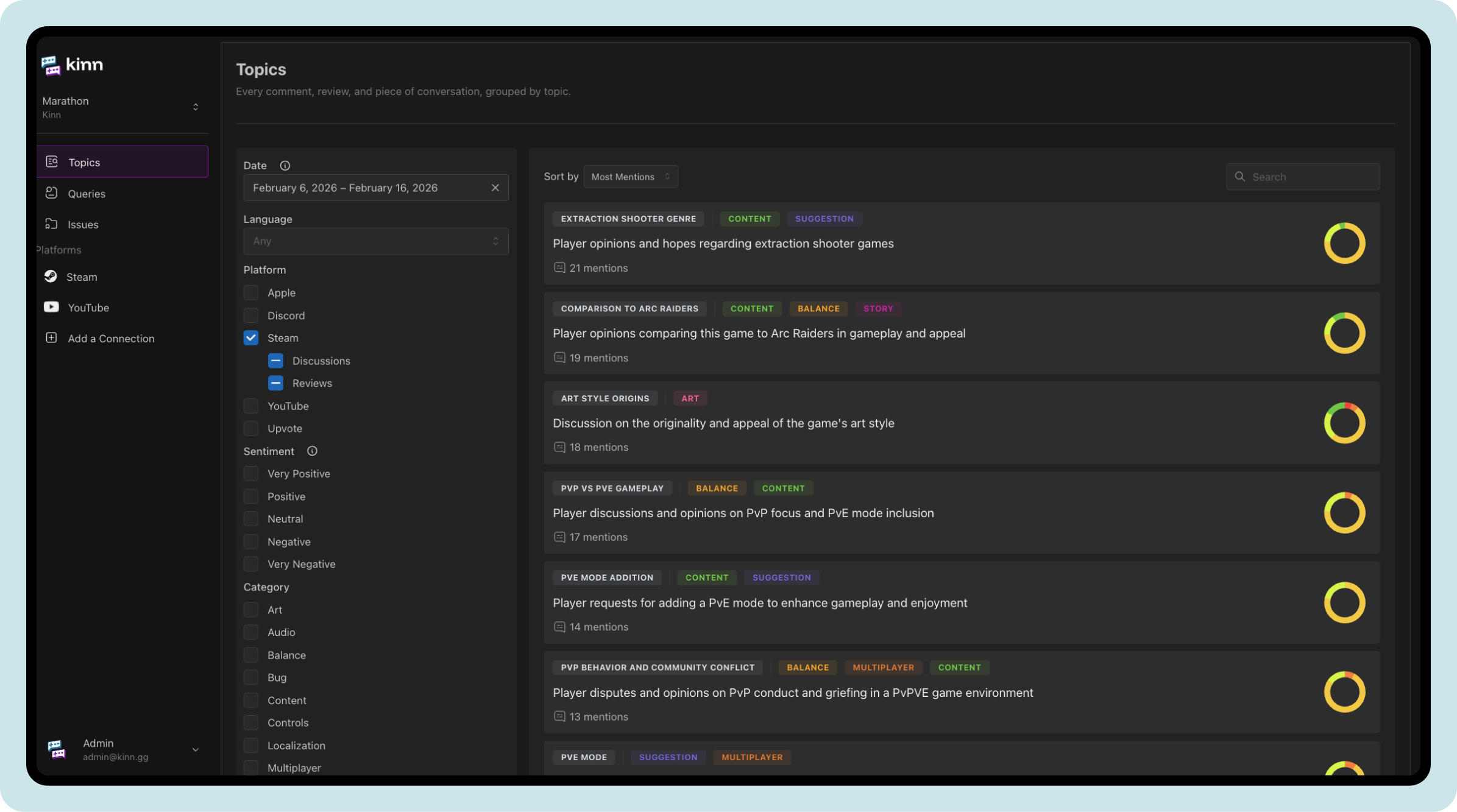
Second, users wanted faster paths to insights. Most often, studios were aware of what was going on in their game, but they lacked the ability to put data behind it. Lots of hunches, few actionable plans. This furthered our thinking that the UX of the existing topic system wasn't really the right fit. Additionally, software is evolving at such a rapid pace, that the traditional SaaS UX is disappearing, and more tools need to be built around automations, and communicating data to AI agents and similar platforms. People are looking for fewer dashboards, more personalization, and quicker results.
Last, we had always planned on building an agent in to Kinn, but we wanted to spend as much time as we could to build stable data management and infrastructure. The last thing we wanted to do was try to build an entire product that was flashy, but struggled with basic tasks. So we spent most of our first year really trying to understand the challenges of studios to ensure that we would be able to find product-market-fit as seamlessly as possible. And in an industry already skeptical of AI (often with good reason!), we knew that a big part of that would be building something so accurate that even the strongest AI critics could respect the results. In short, we didn't want to "build AI" for the sake of building another AI tool.
That leads us to where we are today. In our first year, we observed 65 games in Kinn. Now with millions of comments and videos to study, we finally are confident in Kinn's ability to understand players the way the best teams do. Nothing breaks confidence in AI when two people can inject the same prompt and get completely different answers, especially around verifiable KPIs. And as any studio would attest, communities can be... a lot. Between sarcasm, jargon, memes, or even hostile behavior, understanding commentary across the web necessitates a very human approach. Today, we're really proud to see how accurate and consistent results can be in Kinn.
This all goes live on Friday, April 3rd.
The Kinn agent is fundamentally quite simple. It's an LLM layer that sits on top of all your player, community, and game data. You interact with it like you would any other model such as Claude or ChatGPT. You can ask it questions about your game, your players, opinions on patches, weapon balance, or new maps to be put in the ranked pool. It's kind of like standing in an ampitheater of all your players, and you can simply talk to them.
Unlike broad-use models, Kinn's LLM is sourced completely from your own data. That means it understands in-game jargon, patch notes, and doesn't go out and try to find the highest ranking content from the internet to serve results.
If you've ever used even the most frontier models or deep research, you'll often run in to API limitations and hallucinations. For example, ChatGPT often confuses Battlefield 2042 as the sequel to Battlefield 6. Or will frequently source a random blog from 2024 because it continues to rank highly in search engines. This doesn't happen when you control the data pipelines. That's the beauty of Kinn. You control what goes in, so you can ensure quality comes out.
Inherently LLMs are functioanly limited to chat. We're building tools to take that further. And since we have control of what functions the Kinn agent can complete, we are letting our users help us define our roadmap, and monitoring requests and queries closely.
Here are a few ways we've seen studios use Kinn so far:
Since the beginning of Kinn's journey, we've largely worked with community managers in studios. They are the front line between players and decisions makers, and often very tuned in to the conversation. And since testing these new features, we've found more people in a variety of positions from PMs to studio leads, to QA and analysts are getting immense value with Kinn. We have always supported unlimited users, so please invite others in your org to try it out. There's literally no cost.
We have a suite of desired features that are also bundled in to this launch.
Reddit connections. You can now index subreddits
YouTube Auto-Indexing. Channels and playlists can automatically index to Kinn.
Google Play. A highly requested mobile connection.
Jira integration. The very first of many PM tools coming to Kinn.
Sentry integration. Collect crash reports and measure that against reports on other platforms, all included.
50X faster indexing. Particularly helpful for new connections and onboarding fresh accounts.
This version has enabled us to push updates 10x faster, and we have a lot to do
Engine integrations
Closed web search - media indexing, bugs, and forums
Role-based configurations.
Email scraping. Perfect if you have a support@ service for your players.
Alerts and notifications.
Social connections.
More API and Webhook configuration. Great if you're using an in-game feedback portal.
All existing accounts will migrate to the new version on launch day. There is no action needed on your behalf. And any free or trial accounts will be placed on a started plan trial for 14 days. We also have a new feedback form in Kinn as well. So please reach out to us with ideas, interesting use cases, or anything you might want to see.
Onward an upward!